In its own way, the Ephrem workshop carries on the legacy of Vitruvius, a 1st-century BCE Roman author who believed that all architecture worthy of the name must combine three qualities: durability, utility, and beauty (firmitas, utilitas, and venustas).
Ephrem ovens are thus fully in keeping with the Provençal tradition, which is itself steeped in this classical culture. Monuments in this region still stand today that were built according to these same standards, such as the ancient theater of Orange in the Vaucluse department and the Maison Carrée in Nîmes, located in the neighboring department.

Of course, neither the dimensions nor the functions of these structures are comparable to those of the factory’s kilns. But they are guided by the same philosophy of construction: to create with precision, striking a balance between beauty, durability, and utility.
Let’s explore these topics in detail in this fourth article, which I am pleased to be writing for Manufacture Ephrem.
Firmitas: Strength and Endurance as a Founding Principle
The first of Vitruvius’s qualities, firmitas, refers to the solidity, durability, and ability of a structure to withstand the test of time without deteriorating.

At Ephrem, this commitment is reflected first and foremost in the use of carefully selected materials and high-quality French craftsmanship, carried out in the historic workshops of the factory in Villeneuve, in the Alpes-de-Haute-Provence.
The manufacture of such technically sophisticated ovens is only possible thanks to the dedication of a team with genuine artisanal expertise.
The ovens are designed to last, withstand high temperatures, and endure heavy use. The earthen concrete developed by the manufacturer, along with the use of pozzolan and chamotte, fully contribute to this focus on durability.
Indeed, these materials are strong, inert, and durable. Their use is part of a time-honored building approach, inspired by nature, that was already evident in ancient architecture.
In addition to these mineral-based materials, high-quality metal components—custom-made, one by one—are used to construct the frames of these furnaces.
To optimize their performance and durability, all professional ovens are also equipped with a very thick layer of thermal insulation, which enhances their performance over time.
Of course, after prolonged use, certain parts may naturally wear out.
That is why the ovens were designed to allow for the replacement of the relevant components over time.
In this age of disposable goods and excessive consumption, the factory’s teams demonstrate the same common sense as past generations, and maintenance and repair operations go hand in hand with the conservation of resources.
In fact, all ovens also come with a 5-year warranty—and even a 10-year warranty on bakery ovens—which further underscores our commitment to reliability and durability. Everything here is designed to make the oven a reliable and long-lasting tool, capable of supporting your professional practice year after year with complete peace of mind.
Utilitas: Ovens Designed for Convenience
The second of Vitruvius’s principles, utilitas, concerns utility, efficiency, and the perfect harmony between an object and its function.
This is a core value championed by Ephrem: offering a variety of models tailored to your specific needs, while remaining committed to providing the most versatile and ergonomic products on the market.
The line of professional ovens has been designed to offer solutions tailored to a wide variety of uses. From kit ovens and rotary pizza ovens to the Flambeur Pro 90 and 120, as well as down-draft ovens and rotary deck ovens—these are all specialized solutions intended to address specific technical and practical challenges. Each product meets specific needs in terms of usage, production volumes, and, potentially, space constraints.
This extensive range allows us to offer a customized solution for each customer.


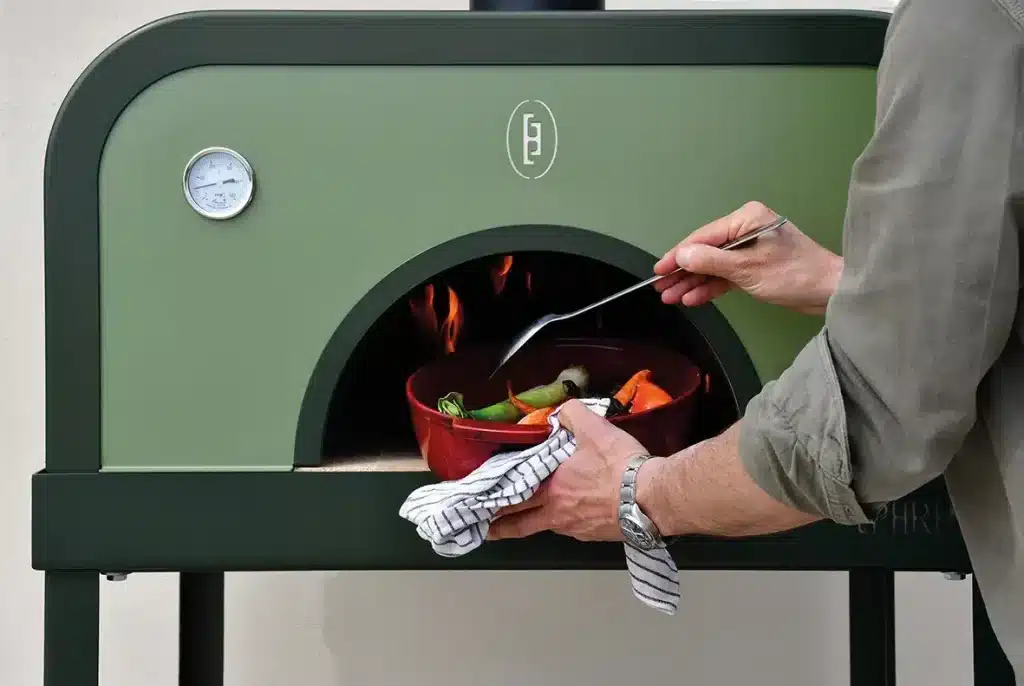
For example, the Flambeur Pro, as its name suggests, allows you to take full advantage of the fire’s intensity. It allows you to flambé and grill while keeping the flame inside the cooking chamber; then, once the embers are removed, you can bake goods before moving on to simmered dishes as the temperature drops. This sequence of uses is characteristic of a versatile tool that supports the transformation of ingredients and the enhancement of dishes in many different ways.
This concept of utility is also evident in the emphasis on ergonomics, which is evident in every tool created by the workshop. At Ephrem, each model is designed to be easy to handle, to make movements more fluid, and to reduce the artisan’s fatigue.
In fact, that’s exactly what I’ve noticed on a daily basis with the 4 m² Boulanger, which I’ve been using for nearly four years now.
I can say that the generous dimensions of its firebox, as well as its waist-high placement, really contribute to greater comfort during use. Its one-meter depth saves me the trouble of handling and cutting wood for long periods, while its height means I don’t have to bend over when loading it, which is much easier on my back.
At Ephrem, technical and thermal performance are therefore closely linked to the issue of user comfort.


Venustas: The Importance of Beauty
The third Vitruvian quality, venustas, reminds us that a successful work must not only be sturdy and useful—it must also be beautiful. The concept of beauty, in this context, is not synonymous with frivolity. It is an integral part of the experience one has with the place or object in question. Its aesthetic qualities must reflect its purpose and inspire a desire to use it.
In recent years, the manufacturer has undertaken a major effort to redesign its line of bakery ovens, resulting in the launch of the Flambeur.
This trend has helped evolve the design of wood-fired ovens toward more contemporary and streamlined forms.
The brand-new Flambeur Pro features sleek lines while embracing a distinctive aesthetic that’s unique on the market. The color options, too, reflect a desire to keep the ovens in step with current trends without losing sight of their traditional roots: black and manganese, terracotta and sand, green and eucalyptus…
In fact, when reading the names of these colors, one can clearly see how nature inspired these creations, and this is precisely one of the beliefs expressed by Vitruvius in *De architectura*. To create beauty, one must draw inspiration from the natural world, particularly the plant kingdom.
Regarding the Flambeur Pro, it’s also worth noting that its open base—while lending a sense of lightness to the structure—also serves a practical purpose: storing firewood. The firewood rests on a metal rack, creating a particularly harmonious aesthetic interplay between these two materials. It is also interesting to note that both of these materials can be transformed by fire—whether during the design process of the stoves or during the culinary preparation process. This resonance undoubtedly makes the whole design feel particularly cohesive to us.
Ephrem ovens therefore fully meet these three objectives set forth by Vitruvius: durability, utility, and beauty. They are thus work companions that are as reliable as they are high-performing, inspiring interest and emotion—both for what they represent and for what they enable us to achieve. They are wonderful tools for preserving our culinary traditions, our living heritage, and the values we need more than ever today.